
Of the published Irish radiocarbon record — some 10,665 determinations in Chapple’s 2019
catalogue — the number ever formally Bayesian-modelled is in the low hundreds, and no published
Irish application of rcarbon’s significance tests could be found. The bottleneck is not the
statistics. It is that the corpus is not in a state where anyone can run them.
radio-rian does the unglamorous part. It takes Chapple’s catalogue — a genuine act of
scholarship, and the only thing of its kind — and makes it analysable: a controlled site-type
vocabulary, the calibration metadata recovered, the ages recalibrated against IntCal20, the
record cross-checked against every other compilation, and extended past Chapple’s 2019 cut-off.
The cleaning decisions are the contribution, and every one is recorded and reviewable.
decided_by=rule) awaiting
human review. The dataset is usable and honest about what it is, but the review passes are not
yet complete — see the caveats on each page. Do not treat the reservoir/soundness flags as final.In one screen
- 11,634
- determinations — 10,665 from Chapple + 969 extended past 2019
- 54,287
- IntCal20 highest-density calibrated intervals (multimodality preserved)
- 9,280
- classified as soundly terrestrial and recalibrated; the rest flagged, not mis-calibrated
- 1,508 → ASI
- free-text site-type strings mapped to the national monument classification
- 6 + 143
- likely transcription errors and duplicate-lab-code collisions surfaced in the source
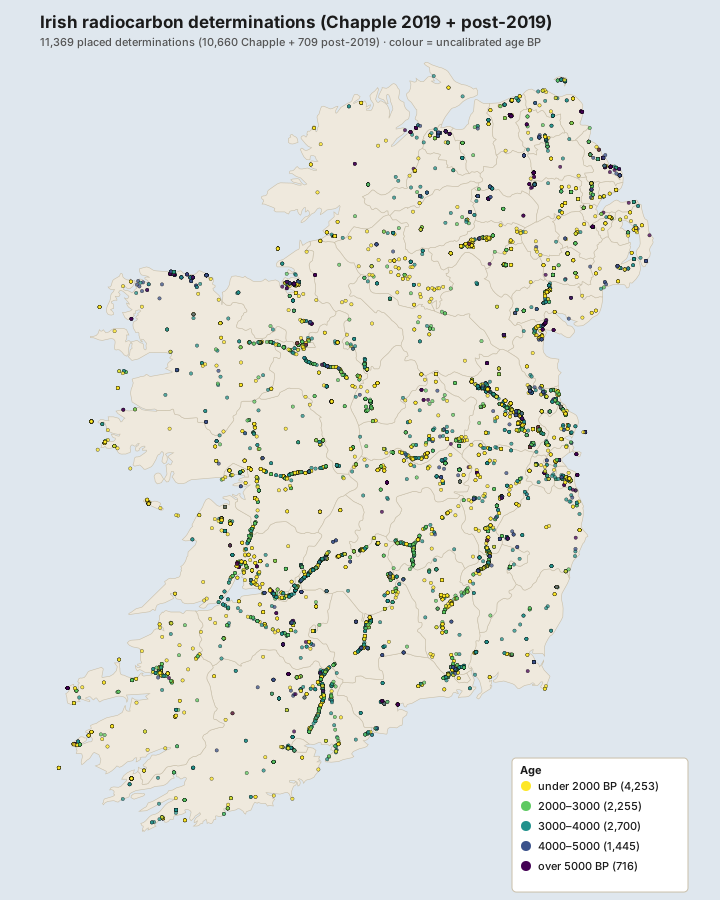
What’s here
- The dataset — the tables, the schema, and how to download them.
- Calibration — reservoir classification and the IntCal20 recalibration.
- Post-2019 — the extension from excavations.ie, the RIA C14 scheme, and TII monographs.
- Findings — the errors and disagreements the cleaning surfaced.
- Method — how it was built, and the review still owed.
Everything is open data. Built on Chapple 2019 (CC-BY-4.0); see the footer for full attribution.