
Post-2019 extension
Chapple’s catalogue is final at August 2019. Roughly seven years of Irish determinations sit in sources he could not include. There is no maintained open compilation of them — that absence is the gap this extension fills. It is inherently a multi-source harvest.
The sources
| Source | Determinations | Notes |
|---|---|---|
| excavations.ie | 158 | interim excavation summaries; only ~2% state an actual determination |
| RIA C14 Dates Scheme | 8 | small, high-quality reports; some dates only in tables |
| TII Heritage monographs | 803 | road-scheme excavation books — the richest source, with δ¹³C/δ¹⁵N appendices |
TII monographs turned out to be the payoff. Their radiocarbon appendices are clean tables that carry δ¹³C and δ¹⁵N per determination — the calibration metadata Chapple’s file mostly lacks. Where they overlap Chapple by lab code (239 cases), they agree on age 97.7% of the time — and the disagreements caught real transcription errors in the catalogue (see Findings).
Extraction, honestly
Core fields — lab code, age, error — are extracted by deterministic regex wherever the report states them inline, so there is no fabrication. Table and multi-line layouts, which regex cannot associate, go through an LLM pass with an anti-fabrication gate: a determination is dropped unless its lab code and age appear verbatim in the source text. Of 61 LLM extractions, zero were fabricated.
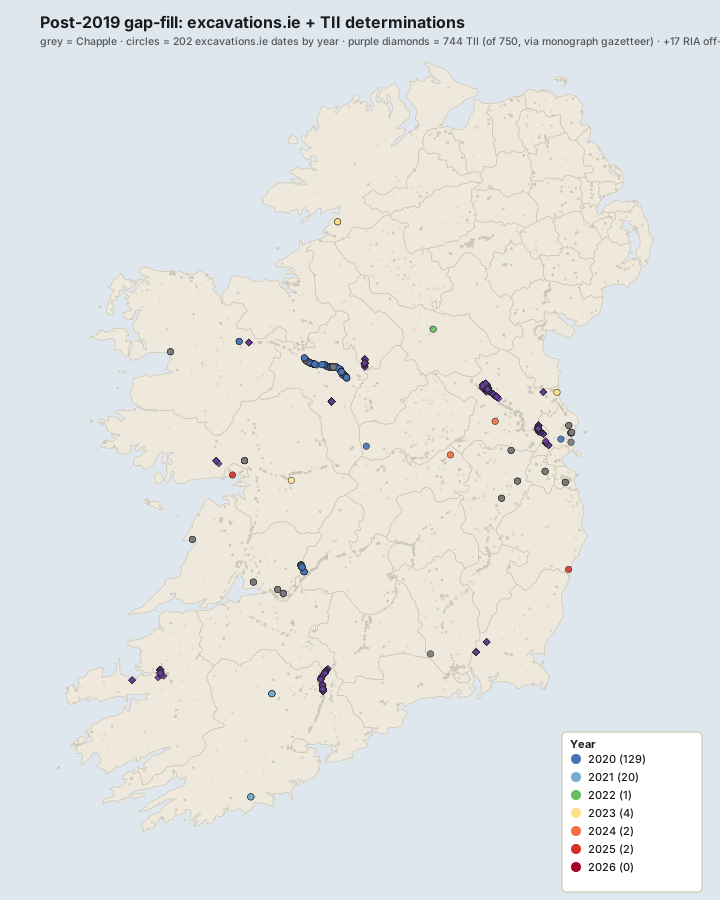
Geocoding
The TII determinations are now placed 99% (744 of 750). Each monograph was read for its own site gazetteer — the grid references printed in its site tables (ITM or Irish Grid, converted to WGS84), the excavation licences (resolved through excavations.ie), or the site names. Only where a monograph states none of these does a determination fall back to its monograph’s centroid, and only for single-site books where that is sound. The 6 left unplaced are genuinely unplaceable — off-scheme comparanda and palaeoenvironmental cores with no site — and are left out rather than guessed. Across the whole corpus, 11,609 of 11,634 determinations carry coordinates; the one remaining gap is the 17 RIA C14 dates, whose reports carry no location field.