“Send the archers!” — Rib-Hadda of Byblos, passim.
A network analysis of the Amarna letters, done carefully.
The Amarna letters (c. 1360–1330 BC) are the diplomatic
correspondence of the Egyptian court under Amenhotep III and
Akhenaten — 382 clay tablets in Akkadian, found in 1887 at Tell
el-Amarna: letters from the “Great Powers” (Babylon, Mittani,
Hatti…) and from the small vassal kings of the Levant, most of
them begging pharaoh for troops that never came.
A well-known study (Cline & Cline 2015, popularized in
Cline’s Love, War, and Diplomacy, 2025) read the archive as
a social network and reported a “small world” with clustering
48.75× a random graph, brokered above all
by Rib-Hadda of Byblos, the archive’s most prolific complainer.
This project rebuilds the Amarna networks from the
Oracc lemmatized
edition with fully reproducible code — one command regenerates
every number, table, figure, and the typeset paper, byte for byte
— and asks which of those findings survive proper null models and
corrections for the archive’s structure. It is, after all, an
ego-network of Egypt, excavated in Egypt: centrality in it measures
salience to Egypt, not historical importance.
What survives, what doesn't
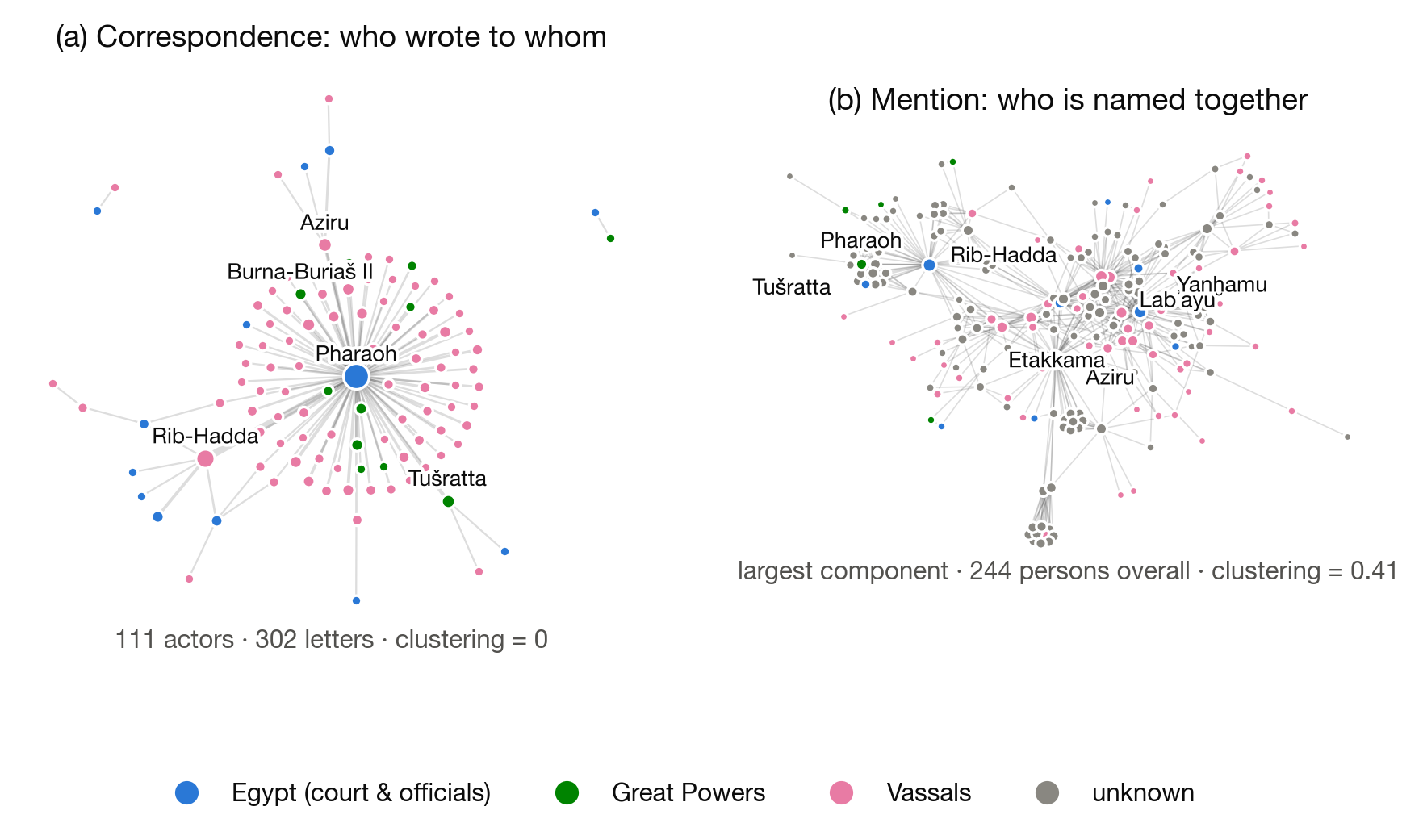
The correspondence network has zero triangles.
Everyone writes to Egypt; almost no one writes to each other
(two vassal–vassal letter-pairs in 302 letters). Whatever the
“small world of the Amarna letters” is, it is not a property
of who wrote to whom.
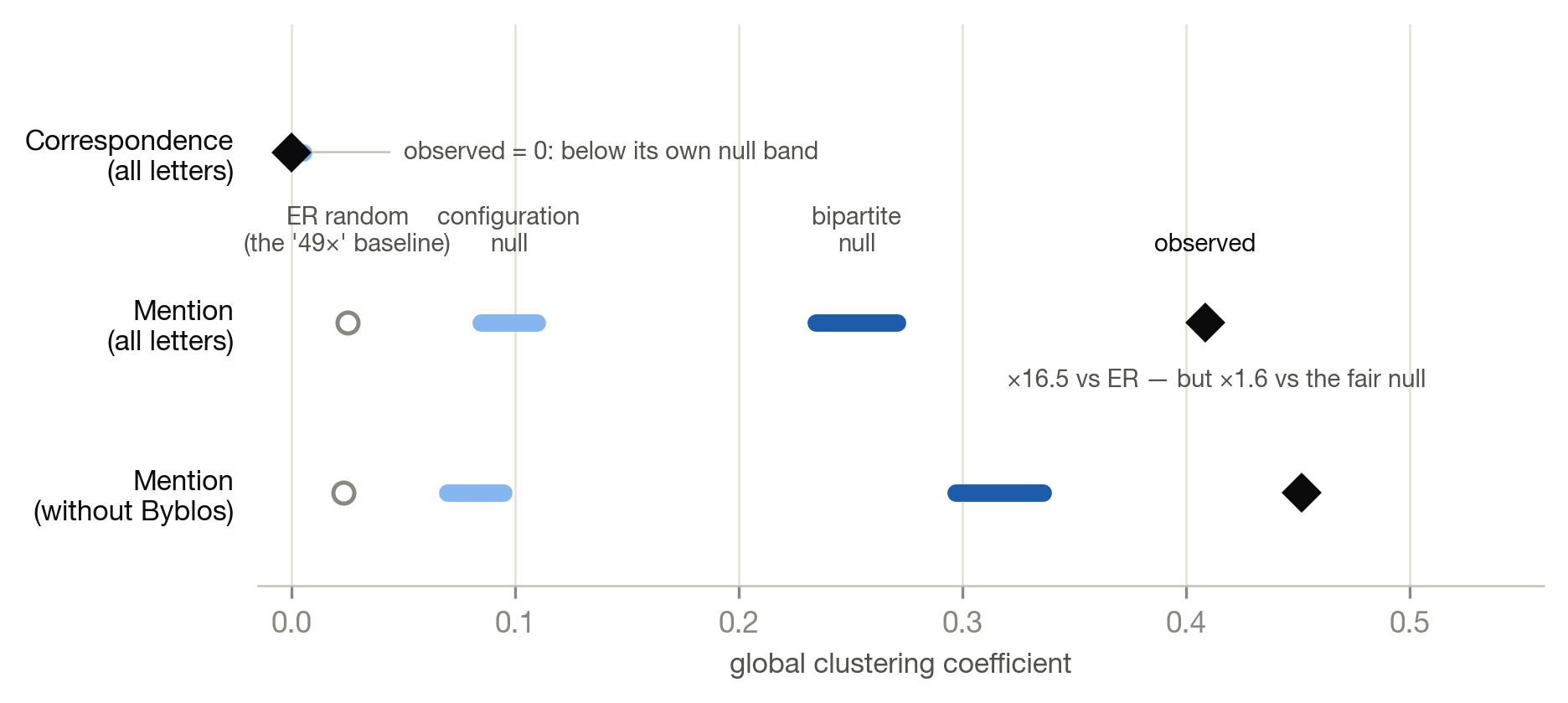
The small world is real — but ×1.6, not ×49.
Rebuilt at full scale, the mention network (persons named
together in a letter) matches Cline & Cline’s object
(244 persons to their
246; clustering 0.409
to their 0.391). Against a null model that
knows letters come in groups — a bipartite configuration null
— the observed clustering exceeds chance by a factor of about
1.6. The astronomical multiplier came from
comparing against the weakest available baseline.
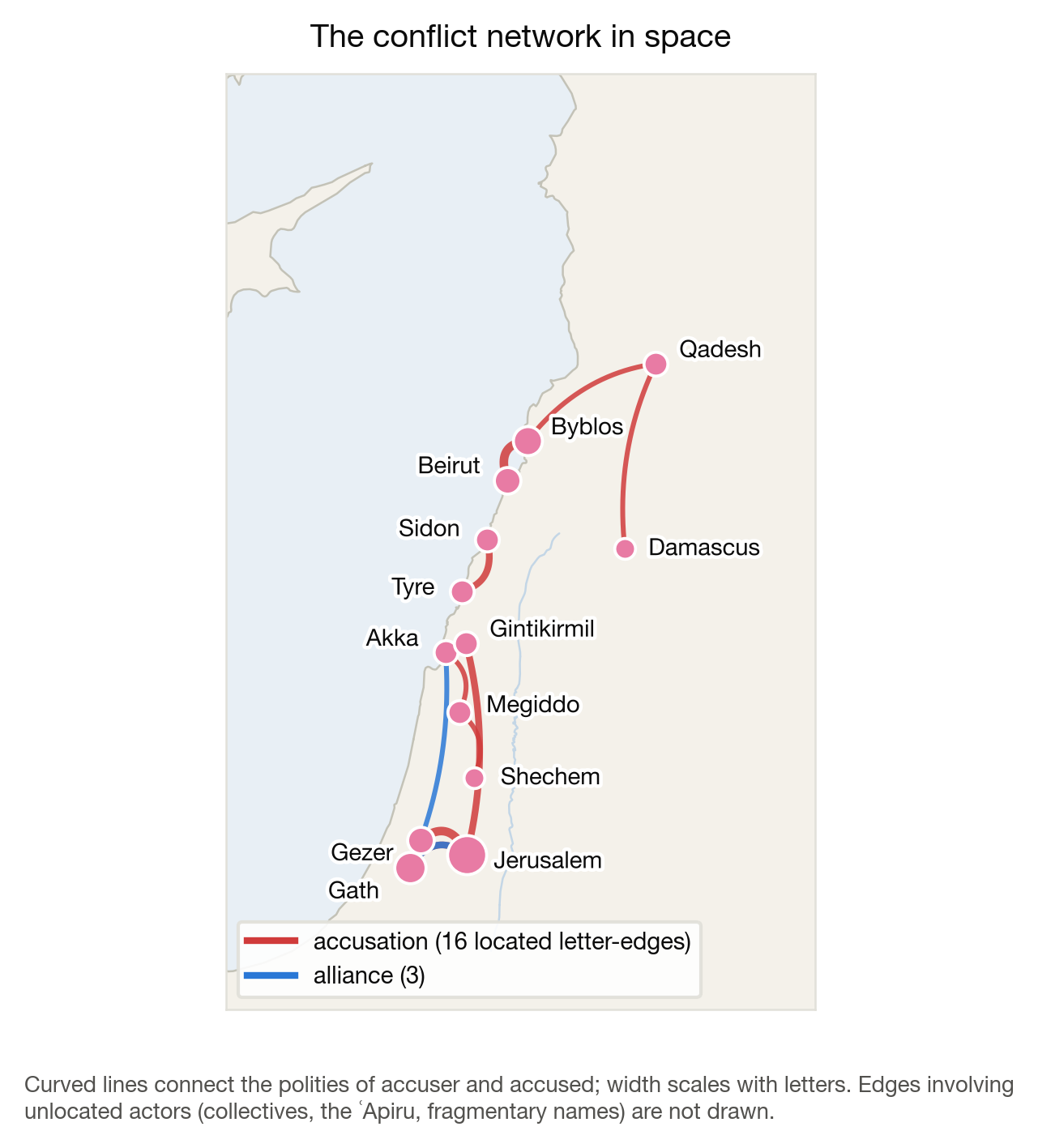
Geography structures whom letters talk about, not who talks to Egypt.
Distance decays mention ties (r = −0.147,
p < 0.001) and conflict ties (r =
−0.298, p = 0.001): neighbors name and accuse neighbors.
Letters to the court show no robust distance effect — the
obligation to write did not thin with the road to Akhetaten.
The two-tier system fits in two coefficients.
An ERGM finds strong reciprocity (+3.78,
concentrated in the Great-Power “brotherhood of kings”) and
strong tier anti-homophily (−2.21):
brotherhood above, servitude below, both materializing as letters to
Egypt and almost never within tier.
Figures
The two layers. (a) Correspondence is a star on
the court — its clustering is exactly zero. (b) The mention
layer — who is named together — is where all the triadic
structure lives.Which null? The multiplier you report is a choice of
baseline: ×16.5 against
Erdős–Rényi, ×1.6
against the fair bipartite null. The correspondence layer sits below its
own null band, at zero.The conflict network in space. Accusations
(hand-coded from hostile language, every edge carrying its source
quotation) run between neighbors: the Phoenician coast, the crowded
hill country between Gezer, Gath, Shechem, and Jerusalem. The one
long-range structure is the Qadesh–Damascus axis of the Hittite
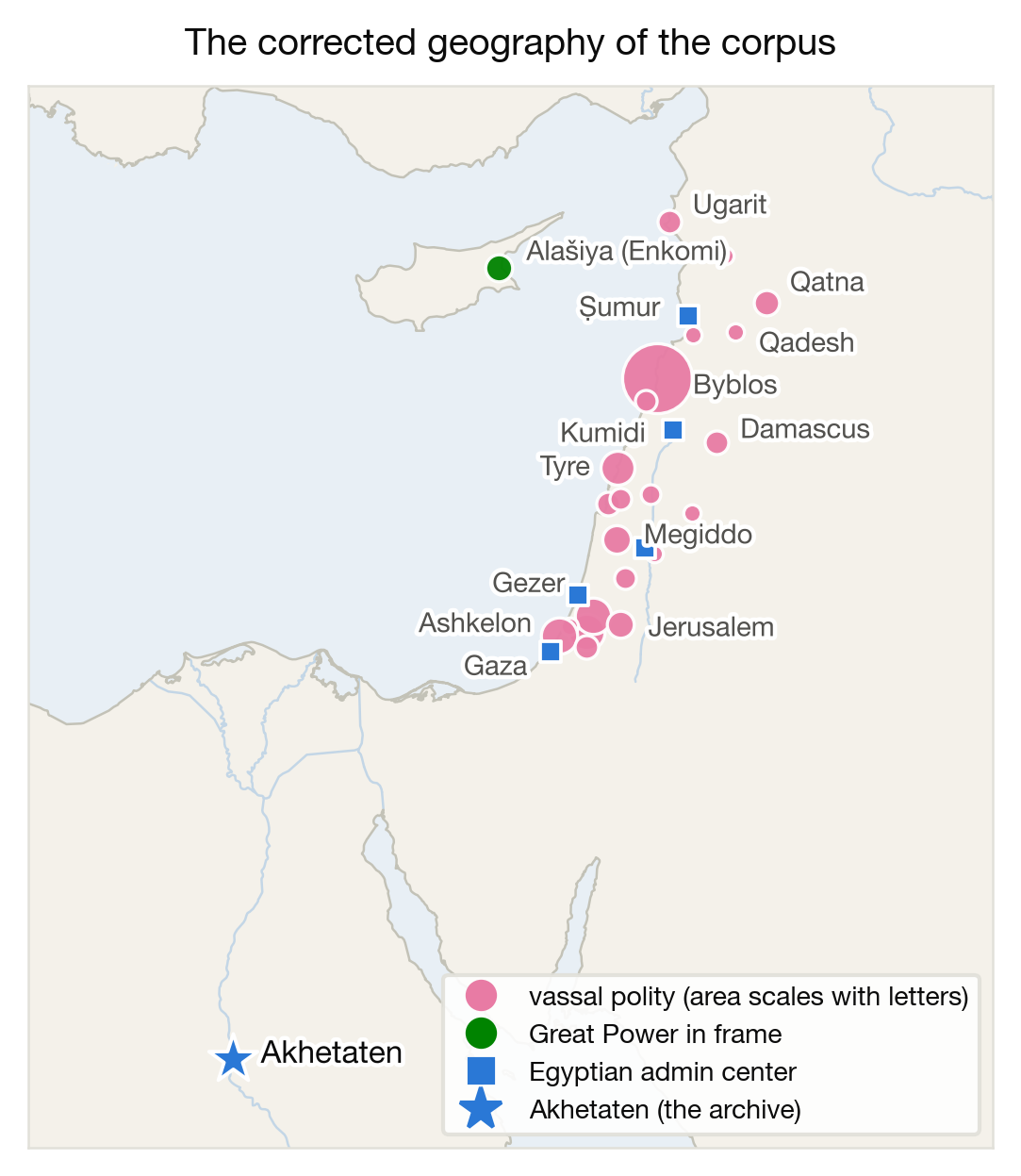
crisis.The corrected geography of the corpus. Vassal
polities sized by letters to pharaoh, the five Egyptian
garrison/commissioner seats, and Akhetaten, where the archive was
found. Every coordinate is verified against the Pleiades bulk
dump.
The paper
The Small World of the Amarna Letters, Revisited: A Reproducible,
Bias-Aware Network Analysis (working draft; target venue
Journal of Historical Network Research). Thirteen pages, six
figures, and every number in it regenerates from
./run_all.sh at the repository root.
Reproduce it
Code (MIT) and hand-curated registries (CC-BY) live at
git.sr.ht/~calgacus/ussira-pitati.
The corpus itself is the Oracc aemw/amarna
edition (Lauinger & Yoder, CC-BY-SA), fetched at build time and
never redistributed. Every hand-coded row — entity aliases,
conflict edges, adjudications against Moran (1992) and Rainey (2015)
— quotes its evidence.