part II — a working draft, not peer-reviewed, not for citation
Conor Reid — working draft of 2026-08-01 — download PDF
Part I established a ceiling: on the Sn-isotope channel the Uluburun cargo bulk's two leading candidates, Cornwall and the Erzgebirge, are unidentifiable in principle — and its value-of-information analysis priced the trace-element channel as the exit. This paper builds that exit and walks through it. We assemble a license-tracked trace-element reference database (8,718 element-analyses across 223 ore specimens, with measurement basis and censoring carried per row), derive per-element smelting-partition priors from published experiments on the disputed ores themselves rather than assumption, and join the chemical channel to the isotope model. Our first fit answered decisively and wrongly — a failure we document because it is the methods lesson — and the rebuilt model replaces all imputation with Bayesian censored likelihoods and propagates reference-parameter uncertainty end to end.
Its results lead, as part I's method demands, with exclusions. Against every candidate source anyone has chemically measured, the cargo's chemistry excludes the alternatives — pairwise Bayes factors of 8–12 against the Erzgebirge (as sampled, at n=7), 7–12 against the Slavkov Forest, 20–42 against Portugal, and effectively no overlap for Spain, nor for Mushiston, whose measured Cu–Sn ores are the natural-bronze argument, priced — and the exclusions hold across every treatment of the ignorance term that stands in for unmeasured sources. Cornwall is the only measured candidate that survives contact with its own reference data; we decline to assert the ordering among survivors, because it is a fact about a prior. The conditional verdict, on the isotope channel's deadlocked pair, is Cornwall over the Erzgebirge at ≈10:1 per batch — and neither the reference-size asymmetry, nor any plausible mass-balance shift, nor a full log-unit of independent per-source systematics flips it. What remains is what no one has measured: Serbia and the Taurus — the map of that gap is this paper's measurement agenda.
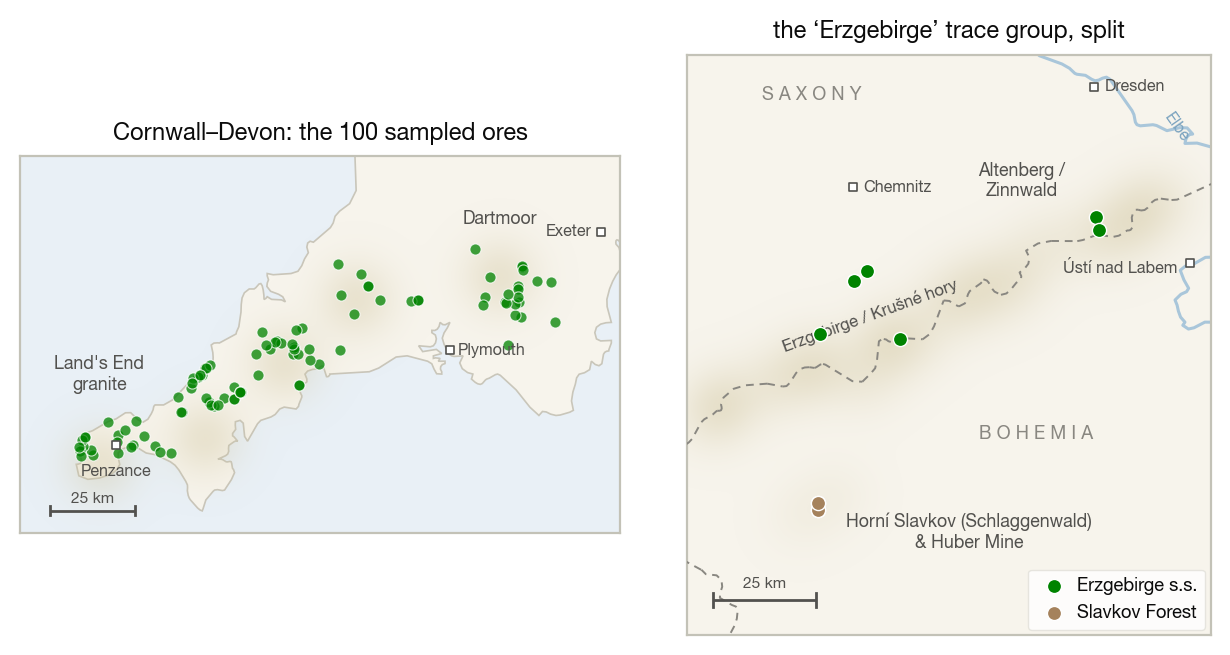
The decisive comparison in this paper rests on 100 Cornwall–Devon ore specimens against seven from the Erzgebirge — which is why the paper spends as much effort trying to break its own verdict as stating it.
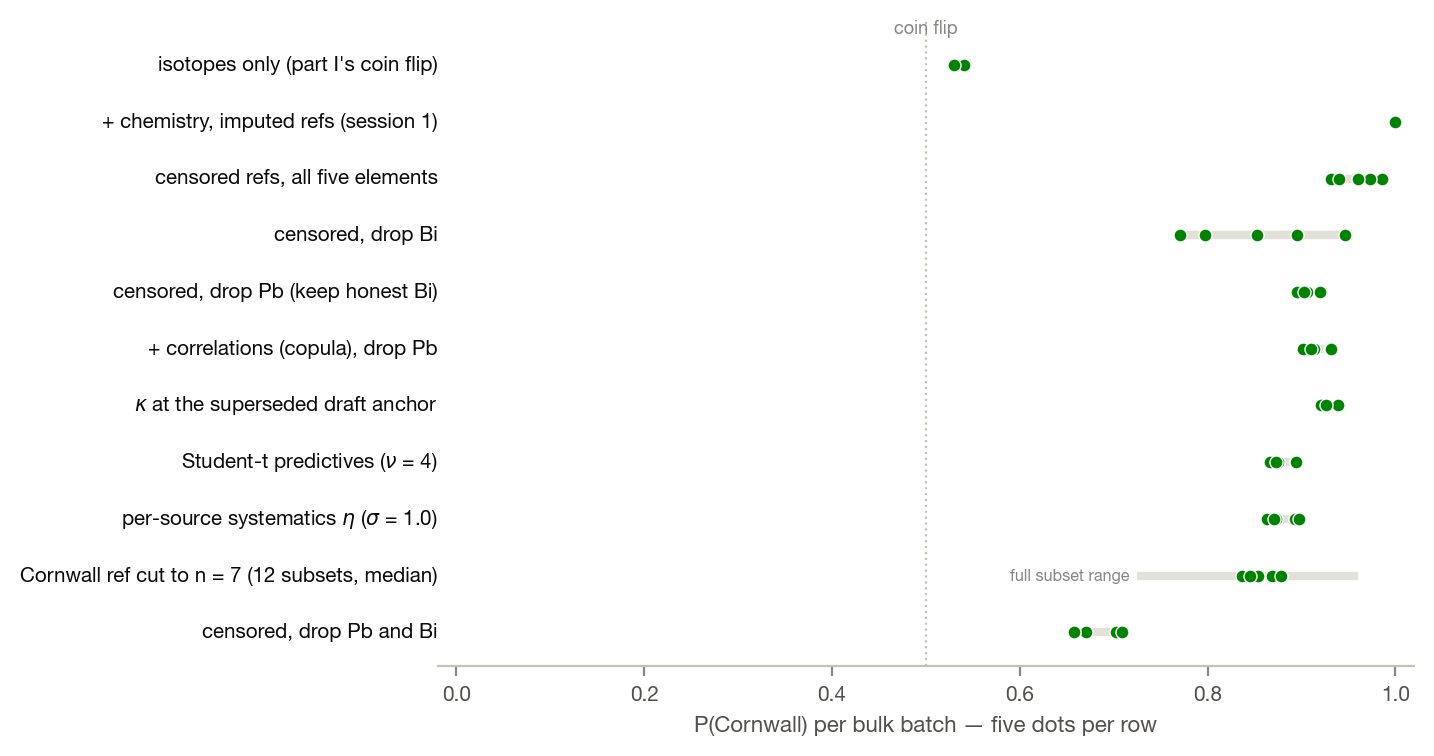
Isotopes alone are part I's coin flip. Imputed chemistry answers 1.000 — for the wrong reason, which the paper documents as its methods lesson. Every honesty measure after that costs certainty, and the verdict survives all of them.
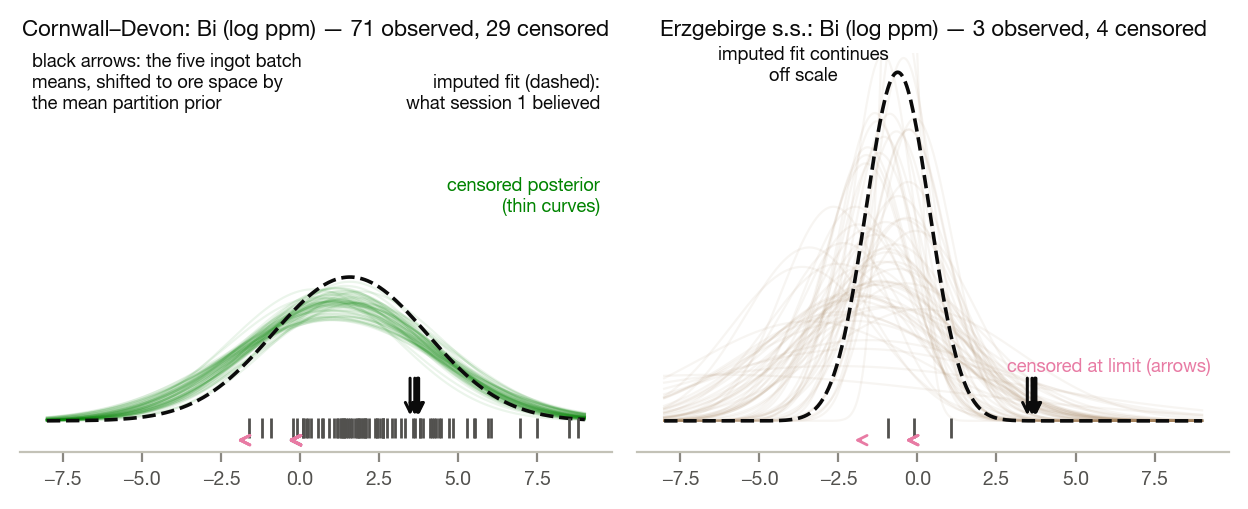
Below-detection values imputed at half the detection limit manufactured a confident Erzgebirge reference out of three observations; Bayesian censored likelihoods replace it with honest width. The black arrows are the cargo batches: inside Cornwall's posterior curves, far up the Erzgebirge's.
Same protocol as part I: external adversarial reviews, each point answered with a computed run or a conceded correction, never rhetoric. Two rounds so far, recorded verbatim with responses in the repository (round 1, round 2). Round 1 caught a real derivation error (the mass-balance anchor of the smelting-partition prior); round 2 demanded the differential-systematics rung that is now on the ladder. The model outputs behind every number are on the data page.
Part I established that the Sn-isotope channel cannot decide between Cornwall and the Erzgebirge in principle, and priced the trace-element channel as the exit. This paper builds that exit: a license-tracked reference database with censoring carried per row, partition priors from smelting experiments on the disputed ores themselves, and a joint model reviewed to the same standard. Its measurement agenda — Serbian and Taurus ore chemistry, an Erzgebirge resample from LBA-plausible workings, one indium-doped smelting experiment, and the field's per-ingot compilations — is where the question goes next.