
wariq
Viking-age silver hoards and Islamic dirhams, machine-readable — with the catalogues’ own uncertainty kept intact.
Viking-age silver hoards and Islamic dirhams, machine-readable — with the catalogues’ own uncertainty kept intact.
Between roughly 800 and 1000 AD, Islamic silver moved north into the Baltic in quantities that are hard to credit. Understanding why means looking at both ends of the exchange, because each had what the other lacked.
The Samanid amirate of Transoxiana and Khurasan held the richest silver mines in the Islamic world, and asserted its independence from Baghdad in the most legible way available: by striking its own coin. The Vikings, on the other side, had no silver mines in any of their territories (Michailidis 2012, 322). Every ounce of silver in Scandinavia was imported, and for a century and a half the overwhelming majority of it arrived as Samanid dirhams.
Silver was one half of a trade. North came coin; south went furs and slaves. Michailidis calls the artery the Fur Route; Kovalev had called it the Fur Road a decade earlier. The two describe the same thing from different disciplines — he from numismatics and the economics of mint output, she from art history and the movement of objects. The Oxford project whose catalogue underlies our hoard data was named, bluntly, Dirhams for Slaves.
The pelts did not originate on the Volga. Kovalev’s reconstruction of the northern network places their source among the Finno-Ugrian peoples of the Pechora, Vychegda, upper and middle Kama, and Oka-upper Volga basins, who supplied the middle Volga with “huge quantities of pelts which were re-exported south”. He reconstructs the mechanism from archaeology and later ethnography: hunting patches worked on multi-day circuits from lodges, with trappers rarely travelling far from their settlements, so that markets at strategic points must have gathered the pelts for onward trade.
That zone is the grey wash on the map. It is drawn apart from the polities because it is a supply region and a cultural area, not a state.
Kovalev has spent a series of studies estimating how much each Samanid mint actually produced — Balkh with Noonan, then Bukhārā, then the two that matter most. Samarqand and al-Shāsh were the primary mints, Samarqand’s output “rivaled only by al-Shāsh”; Balkh and Bukhārā were secondary. He reads the rise of Bukhārān minting in the mid-940s as an attempt by the amirs to supplement declining production at Balkh and Samarqand.
These are the same two mints that dominate the Samanid material in our CNS extraction — al-Shāsh first, Samarqand second.
Two arteries, both attested. The Volga route ran, in Kovalev’s words, from Transoxiana, “traversed Khwarazm, and, thereafter, entered Volga Bulghāria by a caravan route”. Ibn Faḍlān travelled it with the Abbasid embassy of 921–922: a seventy-day journey from Gurgānj, “the last major Central Asian Islamic city on the route”, to the Bulghār capital. It was an overland caravan road across the steppe — not a descent to the Caspian and back up the river, which is why Itil sits on the Caspian branch of our map and not on the Volga route.
The Dnipro route — the “route from the Varangians to the Greeks” of the Russian Primary Chronicle, described in detail by Constantine Porphyrogenitus (De administrando imperio ch. 9) — connected the Black Sea to Novgorod and Ladoga through Kiev.
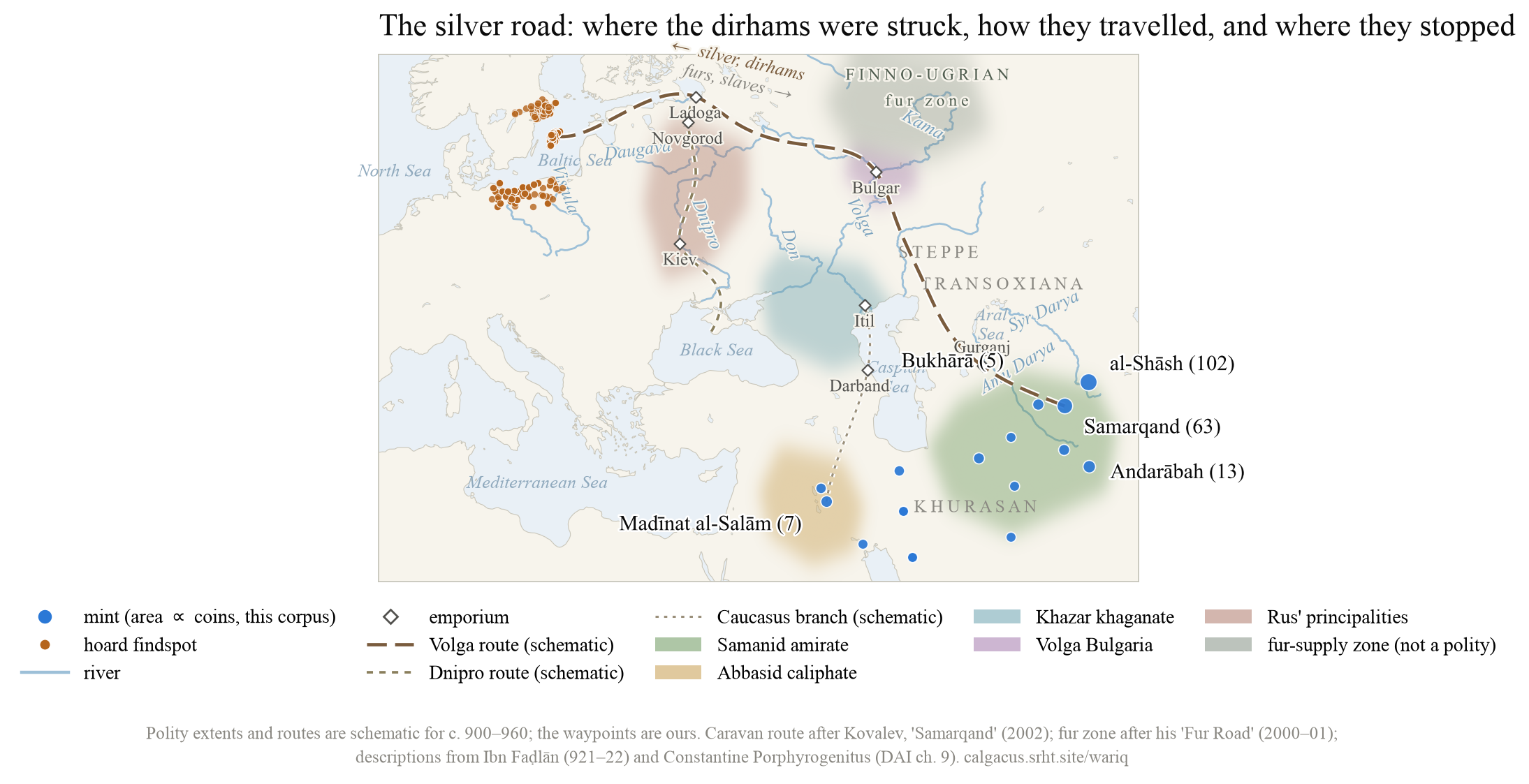
Neither Samanid merchants nor Vikings travelled the whole way. Khazaria and Volga Bulghāria acted as intermediaries in commerce between the Near East and the Rus’ lands — the subject of a study Kovalev inherited from Noonan and had to rebuild from scratch, having been unable to find the original data in the archive that came to him. Volga Bulghāria’s position at the Volga–Kama confluence put it exactly where the fur network met the caravan road.
Control of the route was also political. Kovalev reads the Russian Primary Chronicle’s account of Grand Princess Olga establishing fiscal outposts (pogosty) along the Msta in 947 as regulating and limiting the flow of Islamic silver into the Baltic — after which a larger share was retained in the Novgorodian lands and re-channelled south to Kiev as tribute. The northern silver supply was not only a matter of how much the mints struck.
More than half a million Kufic dirhams have been recovered from over 2,100 hoards across Afro-Eurasia, most of them in eastern Europe and the Baltic. By country, the Samanid totals alone:
| Where | Samanid coins recovered |
|---|---|
| Norway | ~700 |
| Denmark | ~5,000 |
| Sweden | ~85,000 |
| Russia, along the Volga | ~250,000 |
And those are only the coins that were buried, survived and were found.
A fact with consequences for anyone comparing archives: 98.3% of al-Shāsh dirhams and almost 97% of Samarqand dirhams were recovered from hoards in eastern and northern Europe. There is little evidence that Samanid dirhams circulated in quantity within Central Asia or anywhere else in the Islamic territories at all.
So a museum collection assembled on the market will rarely see an al-Shāsh dirham, while a Baltic hoard is full of them. That is precisely the pattern on the mints page, and it is why this project sizes its map by its own coins rather than substituting a larger but differently-biased collection.
Kovalev’s cohort analysis of Samarqand and al-Shāsh finds that “the later a dirham was issued, the quicker it was deposited”. Of coins struck in 287 AH/900 AD, slightly over half were in the ground within fifty years; of those struck in 339 AH/950 AD, 94.8% were.
That is the same collapse our substitution figure shows, measured from the other end. He follows a striking-year cohort forward to burial; we take hoards by closing date and ask how old their coins are. Two independent measurements of a system that stopped being fed.
Around the middle of the tenth century the flow faltered; by about 1000 it had ceased. The causes are debated — mine exhaustion, Samanid political collapse, disruption of the routes, shifts in demand, and the political regulation Olga’s outposts represent — and this dataset settles none of them. What it shows is the shape of the ending: the Islamic share of newly deposited Baltic coin falls from 98% before 960 to 33% in the 990s and 8% after 1000, replaced by German and English silver.
Everything above is established scholarship. This project contributes no new history; it contributes a machine-readable form of two catalogues that had none, so that these arguments can be counted, joined and checked rather than only read. Against half a million recovered dirhams, 548 hoards and 394 coins is a small sample — but it is a sample anyone can query, and until now there was no open corpus of Islamic or dirham hoards at all.