wariq
Viking-age silver hoards and Islamic dirhams, machine-readable — with the catalogues’ own uncertainty kept intact.
Viking-age silver hoards and Islamic dirhams, machine-readable — with the catalogues’ own uncertainty kept intact.
77 mint names, normalised across transliteration traditions and aligned to Nomisma.org URIs where they exist. 64 of 77 align; the rest are candidates to contribute upstream.
The normaliser folds diacritics, the several renderings of ‘ayn and hamza (ʼ ʾ ‘ ’ c), sun-letter assimilation and the tāʾ marbūṭa ending, so that al-Shash, al-Shāsh and aš-Šāš resolve to one mint. It does not merge Māʾdin al-Shāsh (the mine) with al-Shāsh (the city), which are different minting operations.
| Mint | Region | Coins | Nomisma | Match |
|---|---|---|---|---|
| al-Shāsh | Transoxiana | 102 | al-shash | matched |
| Samarqand | Transoxiana | 63 | samarqand | matched |
| Andarābah | Khurasan | 13 | andarabah | matched |
| Madīnat al-Salām | Iraq | 7 | madinat_al-salam | matched |
| al-Andalus | al-Andalus | 7 | al-andalus | matched |
| Bukhārā | Transoxiana | 5 | bukhara | matched |
| Balkh | Khurasan | 4 | balkh | matched |
| Naysābūr | Khurasan | 4 | naysabur | matched |
| Surra man raʾā | Iraq | 2 | sur_man_ra'a | variant |
| al-Muḥammadiyya | Jibal | 2 | al-muhammadiyah | matched |
| Madīnat al-Zahrāʾ | al-Andalus | 2 | madinat_al-zahra | matched |
| Marw | Khurasan | 1 | marw | matched |
| Harāt | Khurasan | 1 | harat | matched |
| Zaranj | Sijistan | 1 | zaranj | matched |
| al-Khuttal | Transoxiana | 1 | no Nomisma ID | gap |
| al-Baṣra | Iraq | 1 | al-basrah | matched |
| Iṣbahān | Jibal | 1 | isbahan | matched |
| Shīrāz | Fars | 1 | shiraz | matched |
| Fāris | Fars | 1 | fars_shiraz | matched |
| Jayy | Jibal | 1 | jayy | matched |
| Ṭabaristān | Tabaristan | 1 | tabaristan | matched |
| Urmiya | Azerbaijan | 1 | no Nomisma ID | gap |
| al-ʿAbbāsiyya | Ifriqiya | 1 | al-abbasiyah | matched |
| Suwār | Volga Bulgaria | 1 | no Nomisma ID | gap |
| Sijistān | Sijistan | sijistan | matched | |
| Farwān | Khurasan | farwan | matched | |
| Maʿdin al-Shāsh | Transoxiana | ma'dan_al-shash | matched | |
| Maʿdin Bājunays | Armenia | ma'din_bajunays | matched | |
| Wāsiṭ | Iraq | wasit | matched | |
| al-Kūfa | Iraq | al-kufa | matched | |
| Naṣībīn | Jazira | nisibis | matched | |
| Mayyāfāriqīn | Jazira | mayyafariqin | matched | |
| Iṣṭakhr | Fars | istakhr | matched | |
| Sābūr | Fars | sabur | matched | |
| Ardashīr Khurrah | Fars | ardashir_khurrah | matched | |
| Dārābjird | Fars | darabjird | matched | |
| Hamadhān | Jibal | hamadhan | matched | |
| Āmul | Tabaristan | madinat_amul | variant | |
| Jurjān | Gurgan | gorgan | variant | |
| Kirmān | Kirman | kirman | matched | |
| Arrajān | Fars | no Nomisma ID | gap | |
| Sūq al-Ahwāz | Khuzistan | suq_al-ahwaz | matched | |
| Tustar min al-Ahwāz | Khuzistan | tustar_min_al-ahwaz | matched | |
| Armīniyah | Armenia | no Nomisma ID | gap | |
| Arrān | Arran | arran | matched | |
| Dimashq | Syria | dimashq | matched | |
| Miṣr | Egypt | misr | matched | |
| Ifrīqiyah | Ifriqiya | ifriqiyah | matched | |
| Tudghah | Maghrib | tudghah | matched | |
| Ṣanʿāʾ | Yemen | sana'a | matched | |
| Bulghār | Volga Bulgaria | no Nomisma ID | gap | |
| Maʿdin | Transoxiana | no Nomisma ID | gap | |
| Banjhīr | Khurasan | no Nomisma ID | gap | |
| Ūzkand | Transoxiana | uzkand | matched | |
| Abarshahr | Khurasan | no Nomisma ID | gap | |
| Walīlah | Maghrib | walilah | matched | |
| Bardhaʿah | Arran | barda | matched | |
| Ḥarrān | Jazira | harran | variant | |
| Filasṭīn | Syria | filastin | matched | |
| Rāmhurmuz | Khuzistan | ramhurmuz | matched | |
| Māh al-Kūfah | Jibal | no Nomisma ID | gap | |
| Māhī | Jibal | no Nomisma ID | gap | |
| Junday Sābūr | Khuzistan | no Nomisma ID | gap | |
| Ḥalab | Syria | halab | matched | |
| Raʾs al-ʿAyn | Jazira | ra's_al-ayn | matched | |
| Jannābā | Fars | jannaba | matched | |
| Anṭākiyyah | Syria | antiocheia_syria | matched | |
| Tiflīs | Caucasus | tiflis | matched | |
| Sāriyyah | Tabaristan | sari | matched | |
| Bishāpūr | Fars | bishapur | matched | |
| Qaṣr al-Salām | Jazira | qasr_al-salam | matched | |
| Qumm | Jibal | qumm | matched | |
| Sīrāf | Fars | no Nomisma ID | gap | |
| Dastawā | Khuzistan | dastawa | matched | |
| Rāsht | Gilan | dar_al-marz_rasht | matched | |
| Ḥimṣ | Syria | hims | matched | |
| Manādhir | Khuzistan | al-manadhir | matched |
“variant” means several Nomisma URIs describe one place (e.g. madinat_balkh and balkh); resolved via their shared Wikidata and GeoNames concordances.
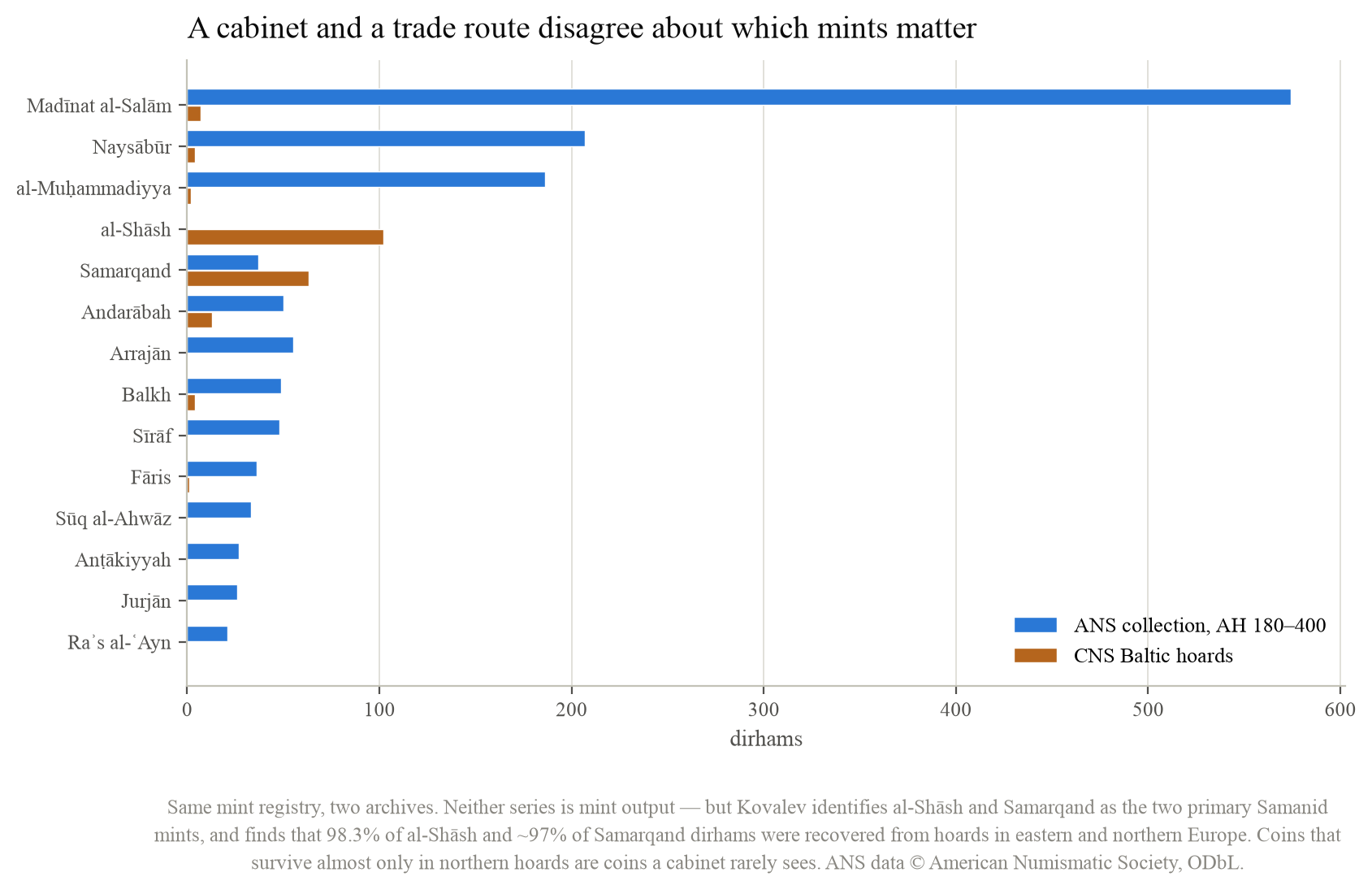
Applying this registry to the American Numismatic Society’s dirhams resolves 4,003 of their 8,193 mint-bearing coins (48.9%) across 50 mints, with no new aliases. That is a useful check — a registry built from CNS and an unpublished hoard catalogue, dropped on a collection it had never seen.
It also produces a result worth pausing on.