
wariq
Viking-age silver hoards and Islamic dirhams, machine-readable — with the catalogues’ own uncertainty kept intact.
Viking-age silver hoards and Islamic dirhams, machine-readable — with the catalogues’ own uncertainty kept intact.
Wariq (وَرِق) is the Quranic word for silver dirhams, from the story of the Seven Sleepers in Sūrat al-Kahf: the sleepers wake after centuries in a cave, send one of their number to town with their wariq, and the antique coin betrays how long they slept. A coin’s age giving away the date of its deposit is exactly the method of this project.
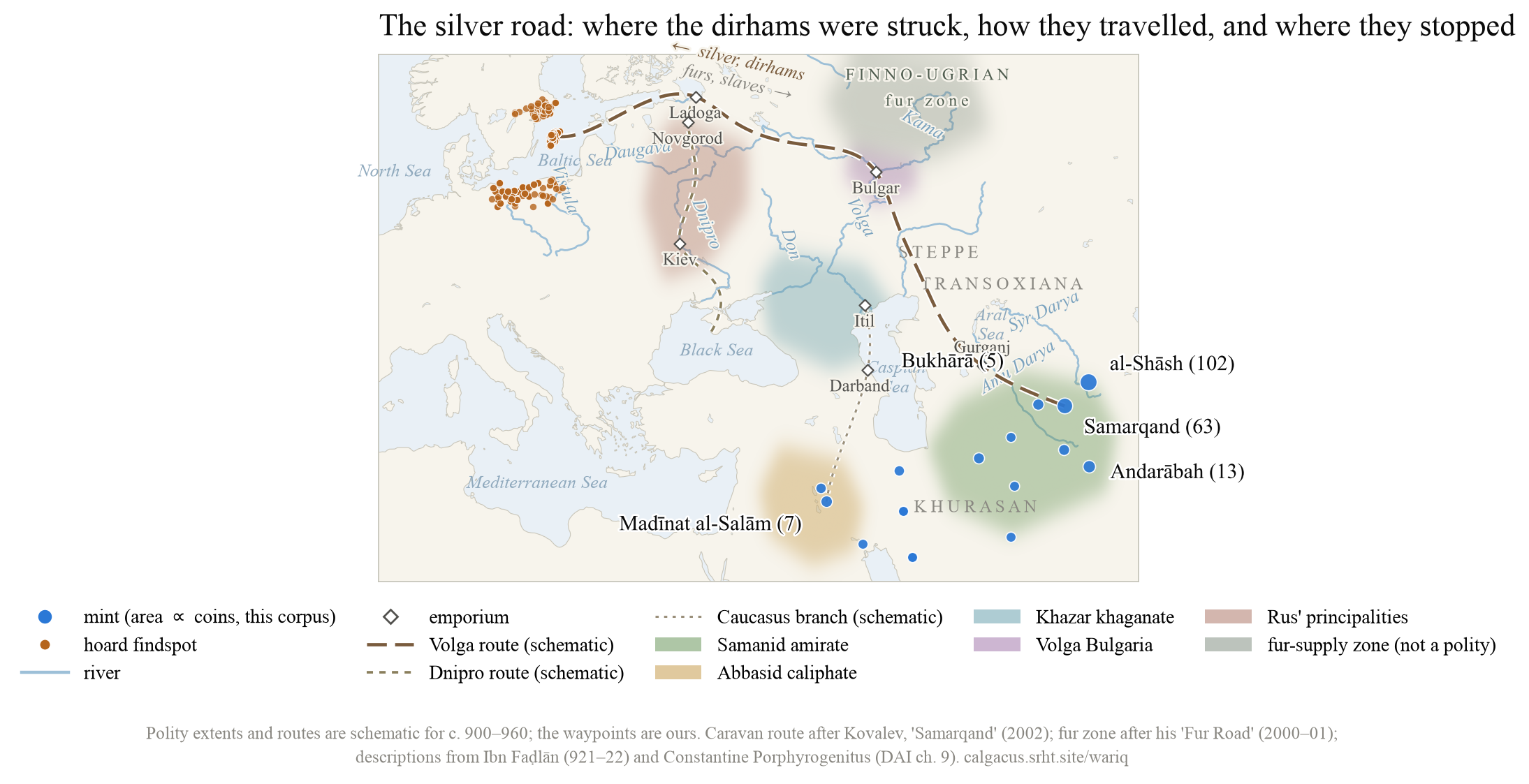
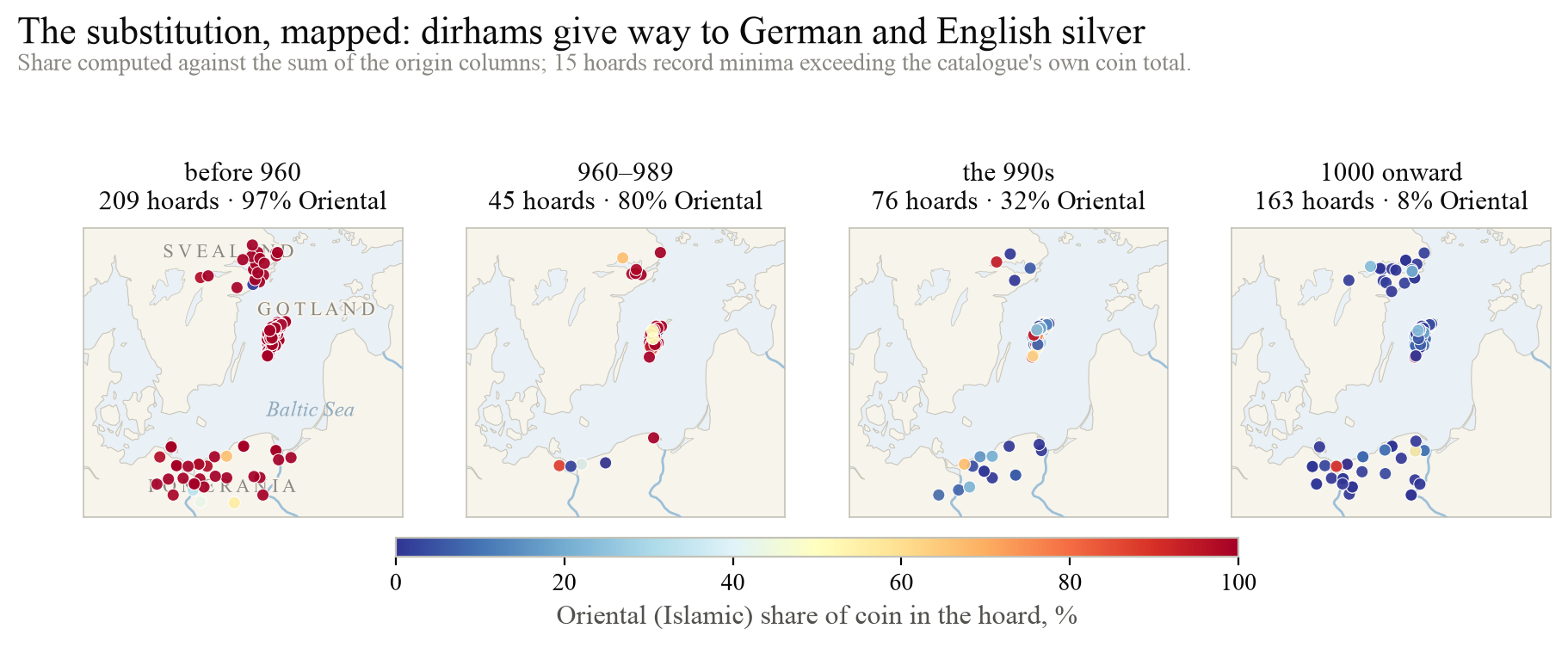
Between roughly 800 and 1000 AD, Islamic silver flowed north through the Rus’ river systems into the Baltic, where it was weighed, cut and buried in extraordinary numbers. It went north because the Vikings had no silver mines of their own, and it went in exchange for furs and slaves — which is why Michailidis calls the artery the Fur Route. Around the middle of the tenth century the flow faltered, and by about 1000 it had stopped. Almost no written source describes the trade directly, so the coins are the archive. More on the silver road →
Two catalogues, extracted to structured data:
Plus a mint registry that folds transliteration variants and aligns to Nomisma.org.
The dataset is deposited and citable at 10.5281/zenodo.21756407 — see Datasets for how to cite it, and what to cite instead for the evidence itself.
That is worth saying plainly. Gruszczynski’s catalogue is an open-access deposit in the Oxford Research Archive; the CNS volumes are posted freely by the Stockholm Numismatic Institute. Nothing here was hidden.
But a catalogue is a PDF. A person can read it; nobody can query it, join it against another catalogue, or count anything in it. Published and usable are different conditions, and the gap between them is where this project sits. There was no machine-readable form of either catalogue before this, and there is still no open corpus of Islamic or dirham hoards anywhere.
That is checkable rather than rhetorical. Querying CoinHoards on 2026‑08‑01 for dirham, Islamic, Umayyad, Abbasid and Samanid returns “No results” for every one, against a corpus of 3,023 hoards (Roman returns 212). Nomisma’s SPARQL endpoint likewise returns zero objects with nmo:hasDenomination nomisma:dirham, zero with nmo:hasAuthority nomisma:samanids, and zero hoards linked to any Islamic mint — while its mint vocabulary carries al‑Shāsh, Samarqand and Bukhārā perfectly well. The authority exists; nothing points at it.
Catalogues record how much of a legend could actually be read. Square brackets mark restored characters, and they fall mid-word: al-Muhammad[iyya], Madinat Nays[abur], 2[93]. Nearly a third of the mint attributions and Hijri dates in these volumes carry such a mark.
Almost every digitisation strips it — including this project’s own first attempt, which ended its mint parser with a tidy .strip("()[]") and destroyed the evidence before anything could record it. The Nomisma RDF ontology has no property for it either, though the NUDS XML schema does; it is lost in the conversion between them.
Here the printed form is kept beside the normalised one, and the uncertainty is a flag rather than a deletion. See Datasets.
This is a small dataset: about 1,500 rows. For scale, Michailidis (2012) gathers the recovered totals from the numismatic literature — ~700 Samanid coins from Norway, ~5,000 from Denmark, ~85,000 from Sweden and ~250,000 from Russia along the Volga. Our 394 coins are a rounding error against that, and those totals are themselves a fraction of a fraction of what once circulated.
So this is not a survey of the trade, and it is not a discovery; it is a transcription — of two catalogues that deserved one, in a field where no open corpus of Islamic or dirham hoards exists at all. The value is in the form, not the volume. The defect log records every error found along the way, including the five in this project’s own code, because a dataset whose mistakes are documented is more useful than one whose mistakes are not.